The Aziziye Mosque—a unique example of late Ottoman architecture in Konya
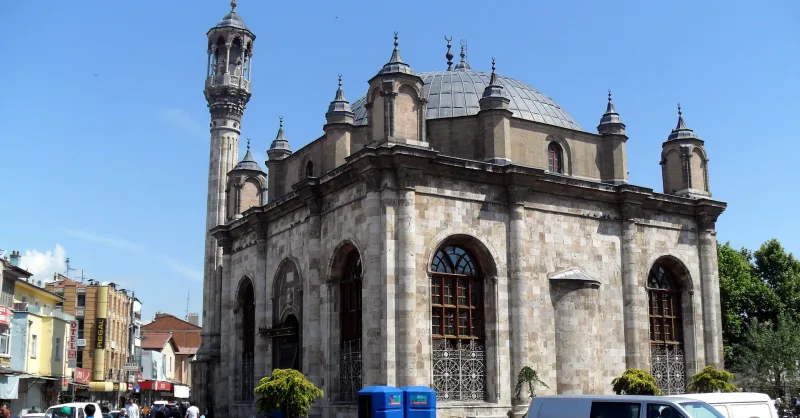
In the center of Konya, in the business district of the Karatay neighborhood, stands the Aziziye Mosque—one of the most unusual religious monuments in Central Anatolia. Its twin minarets with columned balconies immediately catch the eye: no other mosque in Turkey features this architectural design. The Aziziye Mosque was built in 1874 following a fire that destroyed the previous building, by order of Pertevniyal—the mother of Sultan Abdülaziz, whose name gave the mosque its current title. It is the last major mosque erected in Konya during the Ottoman Empire. The combination of late Ottoman eclecticism, Baroque motifs, Neoclassical details, and traditional Turkish layout makes it an architectural manifesto of its time—rich, slightly opulent, and utterly unique.
History and Origins of the Aziziye Mosque
The history of the Aziziye Mosque begins long before 1874. The first building on this site was erected between 1671 and 1676 by Damad Mustafa Pasha—the son-in-law of Sultan Mehmed IV and husband of his daughter Hatice Sultan. This original mosque stood for nearly two centuries until it was destroyed by a fire in 1867, which also engulfed the neighboring shops. The flames left almost nothing of the building.
Pertevniyal Valide Sultan—mother of the then-reigning Sultan Abdulaziz—undertook the restoration of the mosque. This is why the mosque bears the name “Aziziye”: it refers to the name of Abdulaziz. According to the Turkish Wikipedia, the new building was completed in 1876 through the joint efforts of Abdülaziz himself and his mother. The architect’s name has not been preserved—a rare occurrence for a major late-Ottoman structure. The mosque became the last significant religious building in Konya erected before the end of the Ottoman Empire.
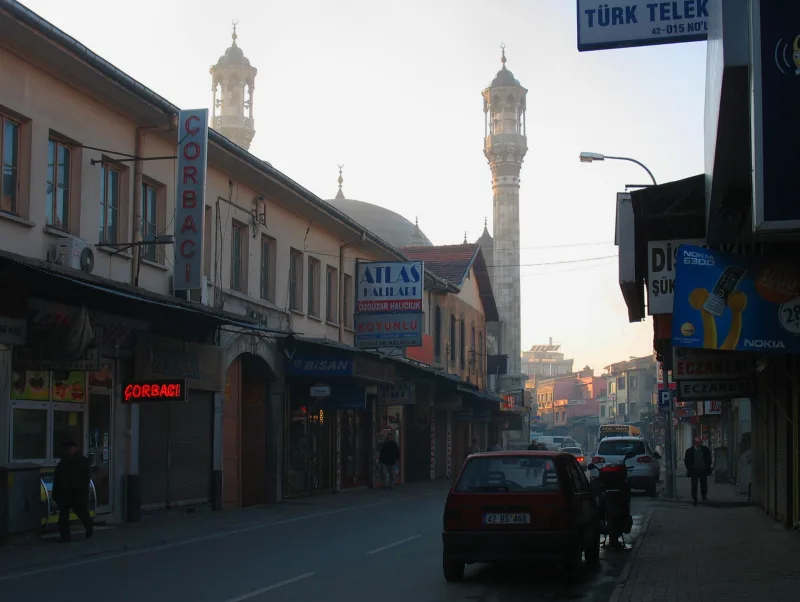
It is located in the city’s business center, in the Karatay district, in close proximity to the Mevlana Museum. This proximity is no coincidence: the neighborhood between the bazaars and the Sufi lodges has always been the heart of Konya’s urban life, a place where commerce and spirituality coexisted. The construction of a large mosque precisely here underscored the status of the revitalized religious center.
In the 20th century, following the abolition of traditional madrasas and Atatürk’s reforms, the mosque underwent restoration several times. Today, it remains an active city mosque, welcoming worshippers for the five daily prayers and open to tourists during breaks between prayers.
Architecture and What to See
The Aziziye Mosque is a vivid illustration of what was called “eklektik üslup” in the 19th century—the eclectic style. Under the guidance of the Balyan architects of Istanbul, this style spread throughout the empire, blending European Baroque, Empire, and Neoclassical elements with traditional Ottoman layout. The result was buildings that were luxurious, ornate, and somewhat resembling a cake with cream swirls—and in terms of scale and meticulous craftsmanship, Konya’s Aziziye ranks among the finest of them.
Minarets with columned balconies
The mosque’s main highlight is its two minarets, whose gallery-like sherefes are supported not by solid masonry but by slender columns. This design is unique to Turkey: nowhere else is there a similar colonnaded balcony on a minaret. Looking up from below, it seems as though the gallery is suspended in the air rather than resting on stone.
Main facade and portal
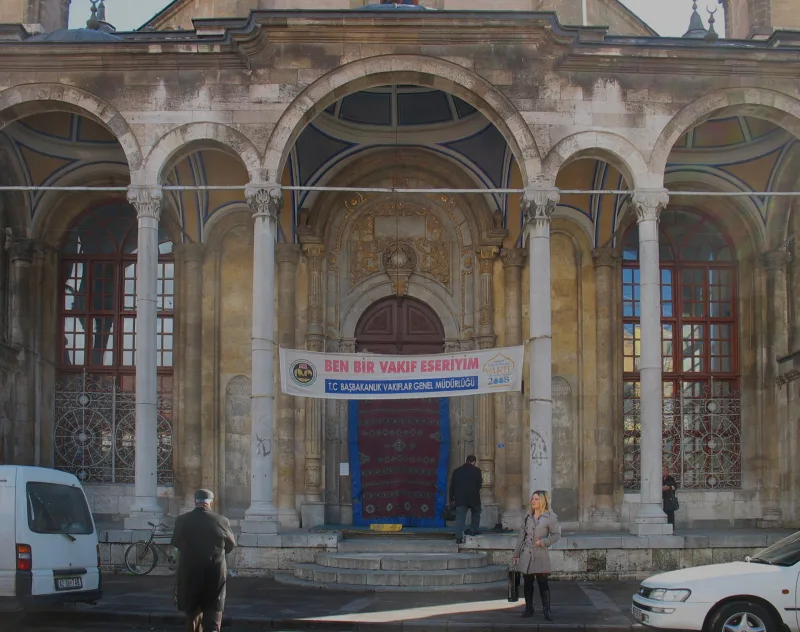
The entire main facade is made of hewn stone. The northern portal—the central entrance—is richly decorated with carvings: twisted columns on the sides, a pattern of lacy arabesques, rosettes, palmettes, and relief scrolls cover the jambs and archivolts with a veritable carpet of ornamentation. On either side of the portal are two mihrab niches with decorated stone vaults. The eastern and western portals are more modest but follow the same design theme.
Prayer Hall and Dome
Inside, the prayer hall has a square plan, covered by a single large dome on an octagonal base. The corner transitions are covered by small semi-domes. The dome’s drum features eight windows that let in daylight. The walls are marked by pilasters that mimic semicircular buttresses on the exterior; at the cornice level, these support architrave capitals in an antique style. Above the walls is a stepped cornice that widens outward.
Narthex and five-domed portico
The entrance to the prayer hall leads through the narthex—a portico consisting of five arched bays, with the central bay being significantly taller and wider than the others—an architectural technique reminiscent of the renowned Selimiye Mosque in Edirne. The portico’s five domes of varying sizes emphasize the hierarchy of the space. The narthex is raised on steps—another atypical solution: typically, in Turkish mosques, the main hall is located at street level.
Mihrab, Minbar, and Interior Decoration
The mihrab is made of bluish local marble—the so-called “gök mermeri,” the sky-blue marble of Konya. Its relief carving combines Baroque scrolls and traditional Islamic motifs: on the arch’s pendants are “Empire-style” gilded garlands, and in the niche is Arabic calligraphy. The minbar is also made of marble: the side panels are decorated with lace-like carvings featuring geometric motifs, and the canopy above the pulpit is supported by four columns. The entire decor is an example of the “neo-Baroque” style that Istanbul replicated throughout the provinces in the second half of the 19th century. The arabesques and medallions with inscriptions on the walls are the work of local calligrapher and decorator Mahbub Efendi.
Basins and Fountains
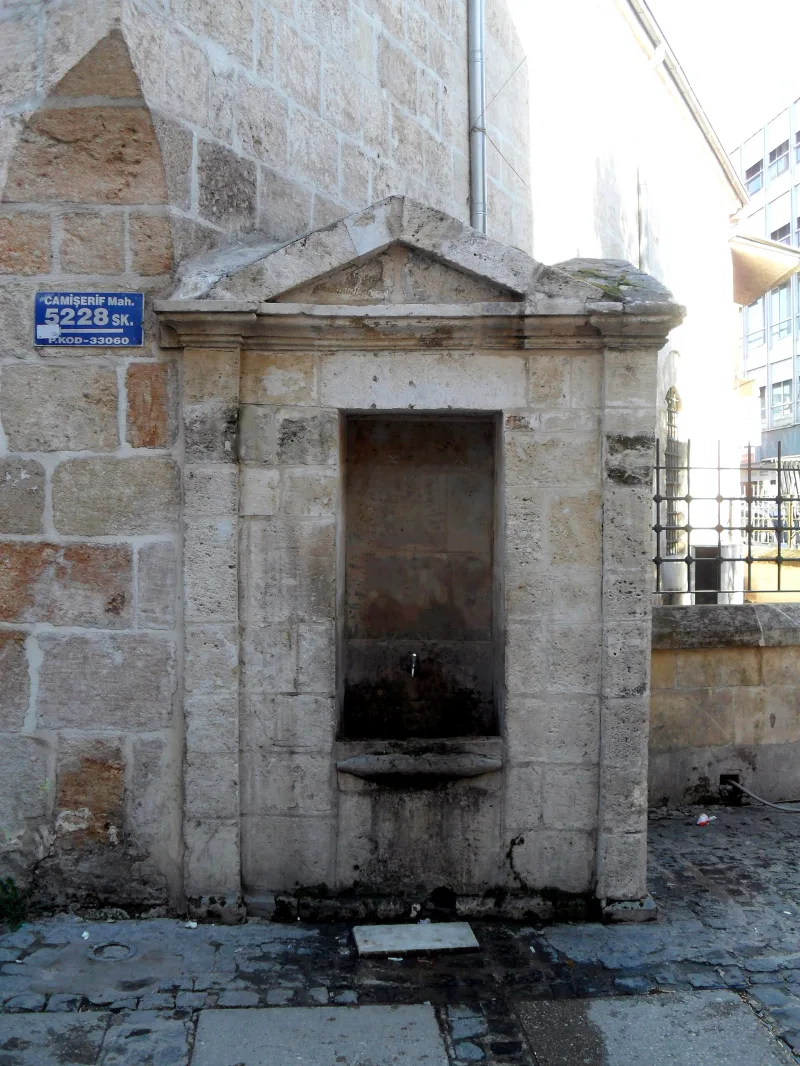
Since the mosque has no courtyard (avlu), the abdest fountains for ritual ablutions adjoin the mosque on the eastern side at the base of the minarets. They are covered by six-columned domes made of white marble. Nearby is a small park.
Interesting Facts and Legends
- The columned sherefes on the minarets of the Aziziye Mosque are unparalleled in Turkey: the balcony gallery rests on slender columns rather than solid masonry—this makes the mosque absolutely unique architecturally.
- The decor of the mihrab and the interior was created by a single master—the calligrapher and artist Mahbub Efendi, who painted the dome, arches, and medallions, blending various styles into a unified whole.
- The mosque was built by order of the sultan’s mother, which is a tradition in itself: the Valide Sultans of the Ottoman Empire often commissioned major religious structures—one need only recall the New Mosque in Istanbul, erected by Kösem Sultan.
- The original building, dating from 1671–1676, was constructed by Mehmed IV’s son-in-law, Damad Mustafa Pasha. In Istanbul, this same architectural patron is associated with several mosques and madrasas from the Köprülü era.
- The Aziziye Mosque is considered the last major mosque built in Konya during the Ottoman Empire—a sort of “farewell gesture” from imperial architecture in this city of Sufis and Seljuk viziers.
How to get there
The Aziziye Mosque is located in the business center of Konya, in the Karatay district, a few minutes’ walk from the Mevlana Museum. Exact coordinates: 37.8699° N, 32.5008° E. From Konya Airport (KYA), you can reach the city center by city bus (Havacılar line) or by taxi—the trip takes about 15–20 minutes. The airport receives direct flights from Istanbul (IST and SAW airports) and Ankara.
From Ankara, it is convenient to travel by Hızlı Tren (high-speed rail): the journey takes about 1 hour and 40 minutes, with trains departing several times a day from Ankara Gar station. There are also direct YHT trains from Istanbul (~3.5 hours). In Konya itself, the mosque is within walking distance of most central attractions: about 300 meters east of the Mevlana Museum and approximately 800 meters from the Alaeddin Mosque. City buses stop on the main street, Aladdin Bulvarı, just a block from the mosque.
Tips for travelers
The Aziziye Mosque is an active place of worship, so visiting hours are subject to the prayer schedule. The best time to visit is between the morning and midday prayers or between the afternoon and evening prayers. Just before the call to prayer and during prayer, tourists are asked to wait at the entrance or observe quietly from the side.
A dress code is required: women must cover their heads and shoulders, and men must remove their shoes upon entering the prayer hall. Free scarves and shoe bags are usually available at the entrance. Photography is permitted inside the mosque, but without a flash and preferably during quiet hours.
The best time to visit is on a weekday morning. On Friday evenings and weekends, there are noticeably more worshippers, making it harder to calmly admire the interior décor. In spring (April–May) and early fall (September–October), Konya enjoys mild weather—the most pleasant time for walks through the city center.
Combine your visit with a tour of nearby attractions: the Mevlana Museum (the mausoleum of the founder of the Mevlevi Order, 300 meters away), the Iplikçi Mosque (13th century), the İnce Minare Madrasa (Slender Minaret), and the Aziziye Bazaar right next to the mosque walls. It’s entirely possible to visit all four sites on foot in a single day in Konya. If you’re coming from Ankara on the Hızlı Tren, a convenient option is a day trip: leave in the morning and return in the evening. Experienced travelers recommend checking the prayer schedule in advance using the Muslim Pro app or the diyanet.gov.tr website—this will save time and allow you to enter without waiting. Finally: don’t leave without looking up one more time at the minarets from the outside—it is these columned sherefs that make the Aziziye Mosque not just beautiful, but truly unique in the architecture of all of Turkey.